
Large Language Models are changing the way people use technology. People are using them for things like chatbots and virtual assistants. They are also using them to create content and translate things. Large Language Models can even generate code. Models like ChatGPT, GPT-4, Gemini and Claude are examples of Large Language Models.
These Large Language Models can understand what people are saying and respond in a way that makes sense. They are really good at understanding language and responding to it. Large Language Models are a part of artificial intelligence now.
This blog tells you what an LLM is and how an LLM is trained, in words that are easy to understand.
What is A Large Language Model (LLM)?
A Large Language Model (LLM) is a kind of computer program that is made to understand what people say and write. This Large Language Model (LLM) is called big because it learns from a lot of things that people have written. It looks at amounts of text data which is a huge amount of writing. This Large Language Model (LLM) has millions or billions of parameters, which is a lot of information that it uses to work properly.
People usually build Large Language Models using learning and neural networks, especially a model architecture called the Transformer. Large Language Models are made with these things, like the Transformer, which is a pretty important part of it.
Key Capabilities of LLMs
- Understand natural language
- Generate human-like text
- Answer questions
- Summarize documents
- Translate languages
- Write code and debug errors
- Assist in research and decision-making
Basic Training of An LLM
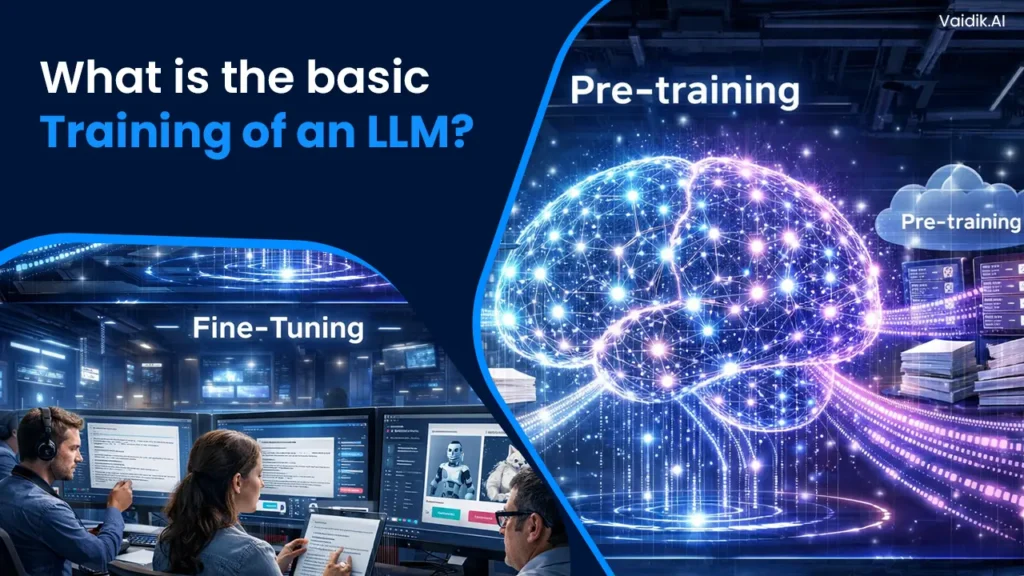
The training of a language model happens in steps. At a level the main goal is to teach the language model patterns in language so it can figure out what comes next and create patterns in language that make sense. This way the language model can produce text that people can understand.
1. Data Collection
The first step is gathering large-scale text data like a lot of words and sentences. We need to collect large-scale text data from places, such as:
- Books
- Articles
- Websites
- News content
- Public forums
- Code repositories
This information is really useful for the model. It helps the model learn about grammar and facts. The model also gets to know about reasoning patterns and different ways of writing. This data is important for the model to learn writing styles. The model learns from this data. It helps the model to write like people do.
Important note: We make sure the data is okay to use by removing anything that’s not good or that can hurt people. The data is. The data is filtered to remove low-quality or harmful content from the data.
2. Tokenization
Before we start training the text is broken down into tokens. These tokens are parts, like words or even smaller bits of words. We are talking about tokens that can be words or parts of words or just single characters.
Example:
“LLMs are powerful” → `[“LLMs”, “are”, “power”, “ful”]`
Tokenization is a way that the model can understand language by using numbers. The model uses Tokenization to break down language into parts so it can process the language. This helps the model to work with the language in a way. Tokenization is really important for the model to work properly with language.
3. Pretraining (Self-Supervised Learning)
This is the core training phase.
- The model is trained to figure out what word comes next in a sentence so it is really good at predicting the token, and that is what the model does: it predicts the next token.
- The computer learns by looking at billions and billions of examples of things. It sees all these examples. That is how the computer learns.
- You do not need to label anything by hand.
Example task:
Artificial intelligence is a thing that people talk about a lot. It is really interesting to learn about artificial intelligence and what it can do for us, and how it is changing our lives with artificial intelligence technology.
Target: “transforming”
Then the model goes through this process the model learns. The model gets to know things during this process. The model becomes smarter. The model learns from this process and can perform tasks more effectively as a result.
- Sentence structure
- Word relationships
- Context and meaning
- Basic reasoning abilities
4. Model Architecture (Transformer)
Large language models use the Transformer architecture which includes:
The attention mechanisms are really important because they help the model focus on the words that it needs to pay attention to. The attention mechanisms make sure the model does not get confused by all the words. This is how the attention mechanisms work: they look at all the words and figure out which ones are the most important for the model to understand what is going on. The attention mechanisms are like a guide for the model, telling it what to look at and what to ignore.
The idea of layers is really important because it helps us understand things on a deeper level. We can look at layers and see how they all work together. This means we can get an understanding of multiple layers and how they affect everything.
Parallel processing is really useful because it lets us train things on sets of data without it taking forever. We can use processing to make things go a lot faster when we are working with large datasets, and parallel processing is very important for that.
The way that Large Language Models are built is what makes them powerful and able to handle a lot of things at the same time. This is because of the Large Language Model’s architecture. It is the Large Language Model architecture that makes Large Language Models really good at what they do.
5. Fine-Tuning
After the model is trained at first it is trained again using high-quality datasets. The model is trained again on these high-quality datasets to make it better.
This step:
This thing really helps to make things more accurate. It makes the accuracy of things better. The accuracy is improved when you use this thing.
- Reduces errors
- Adapts the model for specific tasks (chatting, coding, medical support, etc.)
Fine-tuning of things may include:
- Question-answer pairs
- Instruction-based examples
- Domain-specific data
6. Reinforcement Learning with Human Feedback (RLHF)
To make responses more helpful and safe, we need to think about what people want when they ask for something. Responses should be easy to understand. Not hurt anyone. We have to make sure the information we give is good and will not cause any problems for the person who is asking. When we give responses, we should always think about how they might affect the person who is reading them. This way, we can make sure our responses are helpful and safe for everyone who uses them.
- People who check the quality of things look at what the models come up with and decide if it is good or not. They are called reviewers, and they evaluate the things that the models make which are called model outputs. Human reviewers do this to make sure the model outputs are okay.
- When people give responses, they get something in return for it. The good responses are rewarded
- If the computer gives an answer or one that is not safe, it will get in trouble for that answer. The computer is supposed to give safe answers, so if it gives a bad or unsafe answer that is not good for the computer. The people who made the computer want it to give answers that are safe, and they do not want the computer to give bad or unsafe answers, such as poor or unsafe responses.
This step makes things better:
- Helpfulness
- Politeness
- Safety
- Alignment with human values
Why LLM Training Is Important
Proper training is very important for Language Learning Models. It makes sure that Language Learning Models are able to do their job. Proper training helps Language Learning Models in various ways.
- It helps Language Learning Models understand what people are saying
- It helps Language Learning Models give answers to the questions that people ask.
Proper training is really important for Language Learning Models because it helps them learn and get better at what they do. Proper training makes Language Learning Models very useful.
- Provide accurate information
- Understand context
- Avoid harmful outputs
- Communicate naturally with users
If you do not give an LLM some kind of training, the LLM will just make up things to say, or the things the LLM says will not make sense. The LLM needs this training so that the LLM can give answers.
Applications of LLMs
Large language models are used in a lot of industries including:
- Customer support chatbots
- Education and tutoring
- Healthcare documentation
- Software development
- Marketing and content creation
- Data analysis and research
Conclusion
Large Language Models are a big deal in artificial intelligence. The reason they are so good is because of the massive data they use, the advanced neural networks they have and the multi-stage training processes they go through. From the pretraining to the fine-tuning, where humans give them feedback at each step is important for making Large Language Models smart, useful and safe. Large Language Models need all these steps to work well.
As AI continues to evolve, understanding how LLMs are trained helps us better appreciate their capabilities and limitations.
Categories
Frequently Asked Questions
Massive, diverse datasets, including web scrapes, books, code repositories (GitHub), and scientific articles.
Trillions of tokens (words/sub-words). For example, Llama 2 was trained on 2 trillion tokens.
Tokens are the basic units of text (words, parts of words, or characters) that a model processes, rather than raw text.
Pre-training can take weeks to months, while fine-tuning might take hours or days.
RAG is a technique that connects an LLM to external, private data sources to improve accuracy and reduce hallucinations, allowing the model to look up information rather than relying only on its training data.