
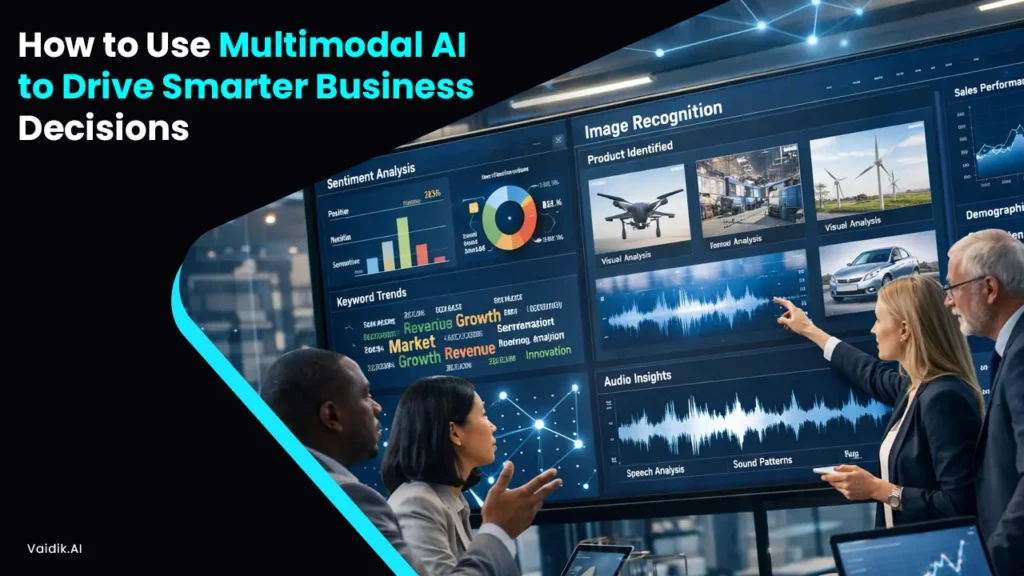
In the economy we have today businesses do not use one source of information to make decisions. They use things like text reports. What customers say about them. They also use images, videos, audio recordings and information from sensors and real-time dashboards. All of these things have information in them.
It has always been hard to get meaning out of all these different kinds of data. Businesses have to deal with text reports, customer feedback, images, videos, audio recordings, sensor data and real-time dashboards. These are all types of data that businesses have to look at.
This is where Multimodal Artificial Intelligence is changing the way we make decisions. Multimodal Artificial Intelligence is really good at looking at lots of types of information at the same time. When Multimodal Artificial Intelligence combines and analyses all this information it helps organizations understand things better.
They can figure out what is going on and make decisions that are faster and smarter. Multimodal Artificial Intelligence is also effective in helping organizations make informed decisions based on actual events, leading to more accurate outcomes. This means organizations can make business decisions with the help of Multimodal Artificial Intelligence.
This blog is about multimodal AI. It talks about multimodal AI’s. It also explains how AI works and why multimodal AI matters. Businesses can use AI in a practical way to get ahead of others and gain a competitive edge with multimodal AI.
What is Multimodal AI?
Artificial intelligence systems that are called Multimodal AI can do a lot of things. They can look at Multimodal AI data, understand Multimodal AI data, and put together kinds of Multimodal AI information. This Multimodal AI information can be things like:
- Text (emails, reports, chat logs)
- Images (product photos, medical scans, satellite images)
- Audio (customer calls, voice commands)
- Video (surveillance footage, marketing videos)
- Structured data (sales figures, financial metrics, sensor readings)
Unlike traditional AI models that operate on a single modality, multimodal AI combines insights across modalities to form a more complete understanding of real-world situations.
Why Multimodal AI Matters For Business Decisions
1. The decisions we make are really complicated.
Have to do with the real world. This is because the real world is a place and our decisions reflect that. Making decisions is hard because the real world is complex. We have to think about how our decisions will affect the world, and that is not easy. The real world is full of problems and our decisions have to take that into account.
Real business problems rarely exist in one format. For example, when a customer has a complaint it can include what they write, the tone of their voice and even screenshots of the issue. On the one hand if we are looking at how a retail store is doing, we have to consider many things like video of how many people are walking into the store, the data from all the transactions, and what the customers are saying about their experience with the retail business.
Multimodal AI mirrors how humans reason by combining multiple signals leading to better judgment and reduced blind spots.
2. Higher Accuracy and Reduced Bias
Relying on a single data type can lead to misleading conclusions. Multimodal systems cross-validate insights across data sources, improving prediction accuracy and reducing data bias.
3. Faster Decision Cycles
When we use automated multimodal analysis we can get insights quickly almost right away. This means organizations can make decisions and do things fast when they are in a spot or when there is a lot at stake with automated multimodal analysis. Automated multimodal analysis is very helpful in these situations because it gives us the information we need from automated multimodal analysis.
How Multimodal AI Works
A typical artificial intelligence pipeline uses various kinds of information. This artificial intelligence pipeline has steps, and it uses this kind of information to do its job. The artificial intelligence pipeline is like a system that uses all these kinds of information.
The artificial intelligence pipeline uses various kinds of information to work properly. This information is very important for the intelligence pipeline.
1. Data Ingestion
- Collecting diverse data sources (text, images, audio, video, tabular data).
2. Modality-Specific Processing
- NLP models for text
- Computer vision models for images/videos
- Speech recognition models for audio
- Statistical models for structured data
3. Fusion Layer
- Integrating outputs from different modalities into a shared representation.
4. Decision or Prediction Layer
- Producing actionable insights such as recommendations, risk scores, or forecasts.
Key Business Use Cases of Multimodal AI
1. Customer Experience & Sentiment Analysis
Traditional Approach:
- Analyzing customer surveys or chat transcripts alone.
Multimodal AI approach:
Combines:
- Call centre audio (tone and emotion)
- Chat transcripts
- Social media images and posts
- Customer behaviour data
Impact:
- Detects dissatisfaction earlier
- Improves churn prediction
- Enables personalized engagement strategies
2. Marketing And Brand Intelligence
Multimodal AI can look at lots of things. Multimodal AI is able to understand Multimodal AI information in ways.
- Ad copy (text)
- Campaign visuals (images/videos)
- Customer reactions (comments, likes, shares)
- Sales performance metrics
Business Value:
- This thing is about figuring out which pictures and words actually make people do something. It knows which visuals and messages drive conversions. So it is looking at the visuals and messages that drive conversions to see what works.
- Optimizes content across platforms
- Improves ROI on marketing spend
3. Risk Management And Fraud Detection
In banking and insurance fraud signals show up in different places. They can be found on the internet, on the phone, and even in person. Fraud signals are a problem for banking and insurance because they appear across multiple channels:
- Transaction patterns
- Customer communication text
- Voice stress in calls
- Document images
Multimodal AI Advantage:
- Detects subtle fraud patterns missed by single-data models
- Reduces false positives
- Enhances compliance and security
4. Operations And Supply Chain Optimization
Multimodal AI integrates:
- Sensor and IoT data
- Warehouse video feeds
- Inventory records
- Maintenance logs
Results:
- Predictive maintenance
- Reduced downtime
- Improved demand forecasting
- Lower operational costs
5. Healthcare And Life Sciences
Healthcare organizations use artificial intelligence to combine things like:
- Medical images
- Clinical notes
- Lab results
- Patient monitoring data
Business Outcomes:
- Faster diagnosis workflows
- Better resource allocation
- Improved patient outcomes
- Reduced operational inefficiencies
How artificial intelligence that uses forms of data improves the way we make important decisions.
Multimodal artificial intelligence is really good at helping us make decisions.
It looks at lots of types of information like words, pictures and sounds to help us figure out what to do. This kind of intelligence is very helpful for making strategic decisions.
Multimodal artificial intelligence improves decision-making in many ways. For example it can look at a picture. Understand what is going on and then use that information to help us make a decision. Multimodal artificial intelligence can also listen to people talking.
Understand what they are saying, which can be very helpful for making decisions. The way Multimodal artificial intelligence improves decision-making is by giving us a lot of different information to consider. We can use Multimodal intelligence to make better decisions because it helps us think about many different things at the same time.
Multimodal artificial intelligence is a useful tool for making important decisions.
1. Context-Aware Insights
Multimodal AI does not just tell us what happened it also tells us why Multimodal AI thinks it happened. This is because Multimodal AI looks at different things that help Multimodal AI figure out the reason.
2. Predictive and Prescriptive Analytics
By learning from patterns that use lots of things Artificial Intelligence can:
- Predict outcomes (sales, churn, risks)
- Recommend actions (pricing changes, staffing levels)
3. Executive-Level Intelligence
Dashboards that use Artificial Intelligence provide:
- Visual summaries
- Natural language explanations
- Scenario simulations
This helps the executives make choices about the company without needing to know all the technical details. The executives can make decisions about the company without having to do a lot of technical analysis. This is really helpful for the executives.
Challenges in Implementing Multimodal AI
So adoption is supposed to be a thing, but it also comes with a lot of problems.
1. Data Integration Complexity
When you are working with kinds of data like numbers or words, and they come from various places you really need to have a good base in data engineering. This is because different data formats and sources require data engineering foundations.
2. Infrastructure and Cost
Working with video, audio and big datasets needs a lot of computer power. You have to have a computer to handle video, audio and large datasets.
3. Model Interpretability
Models that use different things can be tough to understand. This makes people worry about trusting them. If they are doing things right. These models are called multimodal models, and they can be a problem when it comes to trust and following the rules. Complex multimodal models are not easy to figure out so people are concerned about multimodal models.
4. Ethical and Privacy Concerns
When we deal with people’s voices, videos and personal information we have to be very careful. Handling voice data, video data and personal data requires that we follow a lot of rules. We need to make sure we do everything correctly so we do not get in trouble with the law. This is what we mean by governance and regulatory compliance for voice, video and personal data.
The Future of Multimodal AI in Business
As computer programs that think like people get better systems that use kinds of information will:
- Understand context more deeply
- Interact conversationally across text, voice, and visuals
- Enable autonomous decision support systems
Companies that start using AI now will be in a good place to see what is coming, make things personal for their customers, and do better than other companies in a digital world that is getting more complicated all the time.
Businesses that use AI will be able to anticipate change and outperform other businesses. Multimodal AI helps businesses personalize experiences for their customers.
Conclusion
Multimodal AI is a step forward for businesses when it comes to looking at data and making decisions. This is because Multimodal AI brings together things like text and images, audio, video and structured data.
So organizations can now see the picture and make smart decisions that take everything into account. Multimodal AI helps businesses move away from looking at one thing at a time and instead look at Multimodal AI and all the different types of data it uses to make informed decisions.
In a world where speed, accuracy, and adaptability define success, multimodal AI is no longer optional; it is a strategic necessity.
Categories
Frequently Asked Questions
It is a type of AI that mimics human-like perception by understanding and fusing information from multiple, varied sources (e.g., analyzing a video, its audio, and surrounding text simultaneously).
Yes. Small businesses can use existing, pre-trained multimodal models or API services (like GPT-4o or Gemini) rather than building them from scratch, making it accessible for enhancing customer support or marketing content.
Data fusion is the process of integrating data from multiple modalities (text, audio, image) into a single, unified representation, allowing the AI to understand the relationship between different inputs for a more precise outcome.
Agentic AI refers to AI agents that go beyond just analyzing data; they take action, reason, and make decisions autonomously. In a multimodal context, an agent can see a problem (via image), hear user feedback (via audio), and take action (e.g., file a report or fix a system) without constant human intervention.