
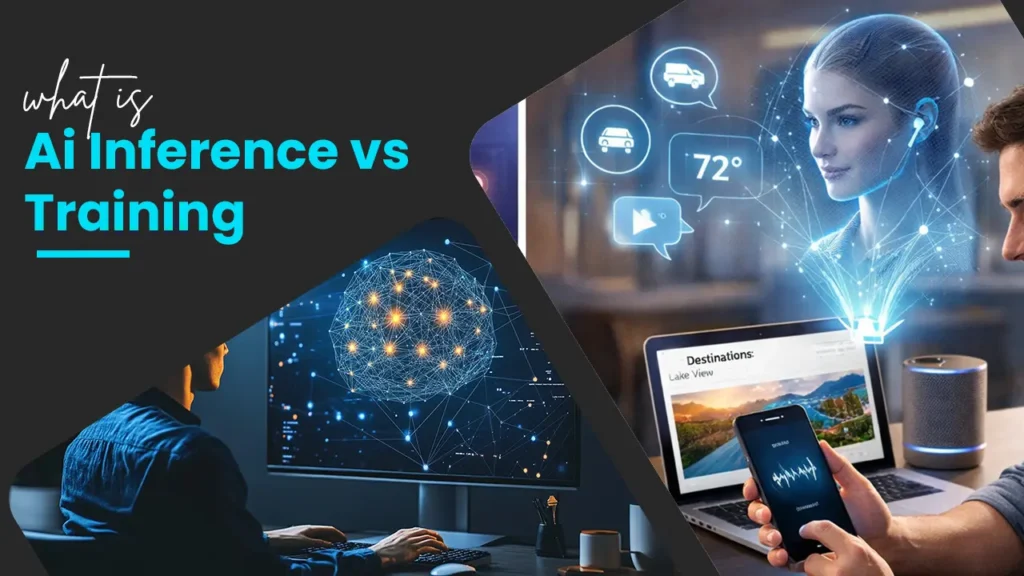
Artificial Intelligence has changed the way things work in industries. It lets machines do things that people used to do. There are two parts to making Artificial Intelligence work: training and inference. These two parts are necessary. They do different things and need different things to work.
You need to know the difference between Artificial Intelligence training and Artificial Intelligence inference to make sure your Artificial Intelligence system works well for what you need it to do.
What is AI Inference
AI inference is what happens when we use a trained model to make guesses or decisions about information that it has not seen before. When we do this we are not changing the model. We are just using what the model has already learned to come up with answers. The model takes the things it knows and uses them to create outputs. AI inference is a part of using AI models because it lets us use what the model has learned to make decisions about new things.
Key Workloads in AI Inference
AI inference is used a lot in the world where people need to make fast and accurate guesses. Some common things that AI inference is used for include:
Real-Time Translation
Translating what people say or write into a language right away is really helpful. This can make it easier for people to talk to each other even if they do not speak the language. It is very useful when you travel to countries, do business with people from other places or need to help customers who speak different languages.
Image Recognition
We use object recognition to find things like objects, faces or scenes really fast. This is useful for things like security systems or augmented reality. When we can recognize things in time, it makes us safer, it helps machines work better on their own, and it makes digital experiences more fun and interactive.
Voice Assistants
When people ask the voice assistants something they listen to what’s being said and give a suitable answer. Voice assistants make things easier for people to use. They are also very helpful. This is because people can use voice assistants without having to use their hands; they just have to talk to the voice assistants in a way, and the voice assistants will do the task for them.
Autonomous Systems
So we have these self-driving cars, drones and robots that need to make decisions. They do this by using the information they get from sensors. When self-driving cars, drones and robots can make decisions quickly, it helps them navigate safely.
It also helps self-driving cars, drones and robots avoid obstacles and change what they do when things around them change. This is really important for self-driving cars, drones and robots to be able to work in environments that are always changing.
AI inference is made to be fast and work well because it usually has to work away. The important things to think about with AI inference include:
Smaller Computational Requirements
When we talk about inference, it usually needs more power from the computer than training does. This is because inference does not need to make any changes to the model.
Low Latency
Inference systems are made to give answers fast. This helps people have a time when they use things like computers and phones. Fast prediction times are very useful for things like chatbots and recommendation engines that need to work in real-time.
Scalability
Inference models can work on lots of devices or platforms. This means they can handle big jobs. It helps companies give people a good artificial intelligence experience at the same time even if there are millions of people using it. Inference models are very useful for this kind of thing.
What is AI Training
AI training is when we teach a machine to do things on its own. We show the machine a lot of information so it can learn to see patterns and make guesses.
The machine looks at all this information. Tries to get better at what it is doing. It does this by changing the numbers inside it that help it make decisions. The machine keeps doing this over and over until it gets really good at what it is doing. This takes a lot of computer power because the machine has to do a lot of work to get it right.
Key Workloads in AI Training
AI training is used in lots of applications across many industries. Here are some of the common things that AI training is used for:
Natural Language Processing (NLP)
We use Natural Language Processing models to teach computers how to understand what people are saying. This is useful for things like chatbots that can have conversations with us. Natural Language Processing models can also figure out how someone is feeling when they talk, and they can even translate languages.
The main goal of Natural Language Processing models is to help people and computers talk to each other better. Natural Language Processing models do this by paying attention to the context of what someone is saying, the tone they are using, and what they really mean.
Computer Vision
Computer vision is really useful for teaching models to recognize objects, faces or scenes in images and videos. This is important for things like vehicles and security systems.
Computer vision systems can help automate analysis. This means they can improve accuracy and speed when making decisions based on images.
They are very good at helping with image-based decision-making for computer vision systems, autonomous vehicles and security systems.
Speech Recognition
We use training systems to change what people say into text for things like voice assistants and transcription services. When speech recognition is good it helps people who need it, makes work easier and lets us use devices without touching them.
Recommendation Systems
We are building models that can guess what users like for content like movies, music or things they can buy. These systems make the user experience better by giving them suggestions that are relevant to what they have looked at before and what they have done in the past. Models that predict user preferences for content, such as movies or music are really useful.
Predictive Analytics
We use training models to forecast trends like stock prices, weather patterns or disease outbreaks.
Training models can help us understand what is going to happen.
Why AI Training is Resource-Intensive
AI training needs a lot of computer power because the tasks are really complicated. Here are some reasons why training the AI system uses many resources:
Large Datasets
Training models usually need a lot of data points like millions or even billions to get good results.
Iterative Process
Models go through a lot of changes to get better. They have to do this three times to make sure they are working right. Each time they do this the model gets a bit better at not making mistakes and getting the right answers. The model sees the data.
High-Performance Hardware
When you are training something you usually need computer parts like GPUs or TPUs. These parts can do lots of things at the same time, which means they can handle big jobs really fast. This helps a lot when you are working with models because it cuts down the time it takes to train them and makes them work better.
Time-Consuming
The training of a model can take time. It can take hours, days, or even weeks. This is because the model and the dataset can be very complex. The time it takes to train a model also depends on the system resources and the model architecture, and the optimization techniques that are used. So it is very important to plan to make sure the training of the model is completed on time. The training of a model requires a lot of planning to get it done quickly.
Comparing Inference and AI Training
Strengths of AI Inference
Speed and Efficiency: These systems are really good at giving answers, which makes them perfect for things that need to happen right away like real-time applications. The Inference systems are designed to be very speedy. That is why they are so good for real-time things.
Scalability is really important. Inference models can be used on different devices. This means that lots of people can use them. Inference models can be put on all sorts of devices, which helps them get used widely.
Drawbacks of AI Inference
The thing about training is that it has an impact on how well the models work. These models are only as good as the training they get. This means they can be affected by biases or mistakes in the training data. The training data is what the models learn from so if the training data is not good then the models will not be good either. The models, like the inference models, are really dependent on the training they receive.
Limited Adaptability: When we use a model to make predictions it does not get better at its job like it does when we are training it. The model is not able to learn things or improve itself over time. This is a difference between training a model and actually using it to make predictions, like inference.
There is a chance that Inference systems will make mistakes. This happens when the information that is put into the Inference systems is not accurate, or if it is different from what the Inference systems learned. If the input data is not good or if it is something that the Inference systems have not seen before then the Inference systems can produce results.
Strengths of AI Training
The ability to learn patterns is really important. Training helps models figure out the relationships within the data. This makes the models very versatile. The ability to learn patterns is what makes them so good at understanding things.
When it comes to customizability models are really flexible. You can make them work better for jobs or industries. To do this you just need to adjust the training parameters. This means models can be tailored to do tasks like tasks for a particular industry by changing these parameters.
The foundation for making guesses is really important. Without learning from a lot of examples, making guesses would not be possible. This is because models need the information they get during the learning process to work properly. The foundation for inference is what helps models make sense of things.
Drawbacks of AI Training
Training machine learning models is really resource-intensive. It needs a lot of power, a lot of time, and a lot of energy. The thing is, all of these things can be very costly. Training these models requires a lot of resources, like power, and this is something that can cost a lot of money.
Designing training algorithms is really hard. It is hard because you need to know a lot about machine learning and data science to do it. Machine learning and data science are important for training algorithms. Training algorithms need people who are good at machine learning and data science to make them work well.
Conclusion
AI training is the initial, compute-intensive process of teaching a model to recognize patterns from large datasets, while AI inference is the subsequent, real-time application of that trained model to make predictions on new, unseen data. Training builds intelligence over days or weeks, whereas inference runs continuously, focusing on speed and efficiency to deliver results in production.
Categories
Frequently Asked Questions
Training is when you put data into a computer program so it can learn. This computer program is called an algorithm. You are basically teaching the algorithm by giving it lots of information. The computer program then creates a model. It does this by changing some things, inside the program to make sure it is correct. It keeps doing this until it gets really good at not making mistakes. The thing is training takes a time. It can take hours or even days to finish.
Inference: The process of using the pre-trained model to make predictions or decisions on new, unseen data, without altering the model. It is generally faster, requiring lower computational power than training
Although training is more intensive per step, it is an occasional expense, while inference runs continuously, often 24/7, for thousands of users. Industry reports suggest that inference can account for 80–90% of the total lifetime cost of an AI system.
Training needs powerful computers, usually a lot of graphics cards or special chips all working together.
Inference: Can run on lighter hardware, including CPUs, specialized Edge AI chips, or cloud-based accelerators optimized for low latency.
The training process has a slow response time. This is not a real-time thing the models are trained when they are not being used, which is usually offline. The training of these models does not happen away it takes some time because of the high latency.
Inference: Low latency (milliseconds or seconds). It requires fast, real-time responses to user inputs.
Training Costs: High upfront (fixed) costs for developing the model.
Inference Costs: Low cost per transaction, but high accumulated (variable) costs over time due to volume.