
Computer vision has become one of the fastest-growing fields in artificial intelligence (AI), enabling machines to understand and interpret visual information with remarkable accuracy.
From autonomous vehicles recognizing pedestrians to healthcare systems detecting tumors in medical scans, image segmentation plays a crucial role in helping AI make intelligent decisions.
One of the most common questions among developers and businesses building computer vision applications is: What is the semantic segmentation vs instance segmentation definition? While both techniques are designed to identify objects within images, they serve different purposes and are suited to different AI use cases.
Understanding the differences between semantic segmentation and instance segmentation is essential when developing AI models for industries such as healthcare, automotive, agriculture, retail, manufacturing, and robotics. Choosing the right segmentation approach can significantly improve model accuracy, efficiency, and overall business outcomes.
In this guide, we’ll explain the semantic segmentation vs instance segmentation definition, compare their key differences, explore real-world applications, and discuss how high-quality image annotation supports successful computer vision projects.
What is Image Segmentation
Image segmentation is a computer vision technique that divides an image into multiple regions or segments, making it easier for AI models to analyze and understand visual content.
Instead of treating an image as a collection of pixels, segmentation groups pixels that share similar characteristics, such as color, texture, or object boundaries.
The goal of image segmentation is to enable AI systems to:
- Detect objects accurately
- Identify object boundaries
- Understand scenes
- Separate foreground from background
- Improve image analysis
- Support autonomous decision-making
Image segmentation is widely used in:
- Autonomous vehicles
- Medical imaging
- Satellite imagery
- Retail analytics
- Industrial inspection
- Robotics
- Agriculture
- Security surveillance
There are several types of image segmentation, but the two most commonly used techniques are semantic segmentation and instance segmentation.
Semantic Segmentation vs Instance Segmentation Definition
The semantic segmentation vs instance segmentation definition can be summarized as follows:
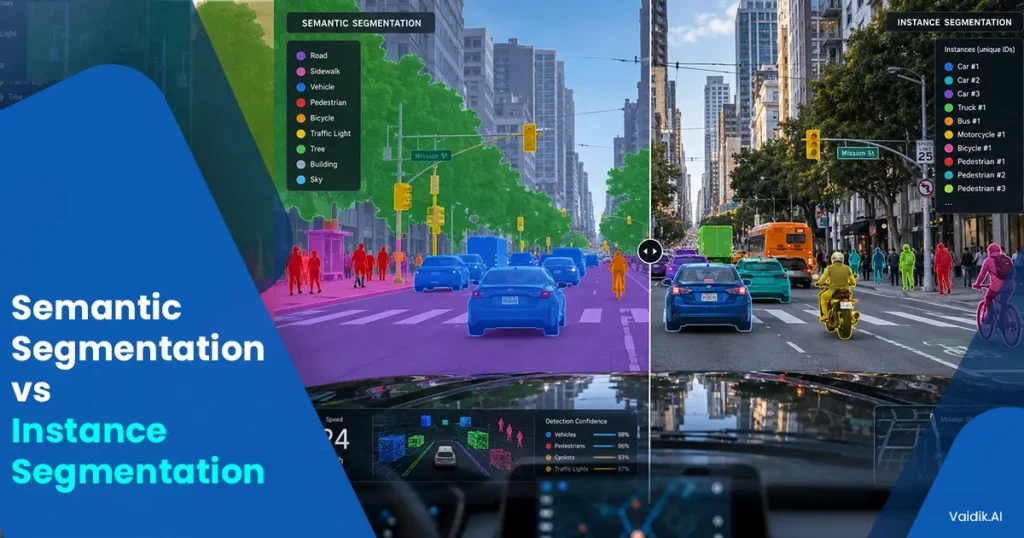
- Semantic segmentation classifies every pixel in an image into a predefined category, treating all objects of the same class as one group.
- Instance segmentation also classifies every pixel but distinguishes each individual object as a separate instance, even when multiple objects belong to the same category.
For example, imagine an image containing five cars.
With semantic segmentation, every car pixel receives the label “car.” The AI knows these pixels belong to the car category but cannot distinguish one car from another.
With instance segmentation, each car is identified separately. The model assigns unique labels, enabling it to recognize Car 1, Car 2, Car 3, and so on.
This distinction is particularly important in applications where identifying individual objects is necessary, such as autonomous driving or inventory management.
What is Semantic Segmentation
Semantic segmentation is a deep learning technique that assigns a class label to every pixel in an image.
Rather than detecting individual objects, semantic segmentation focuses on identifying the category each pixel belongs to.
For example, an image may contain:
- Road
- Sky
- Building
- Tree
- Car
- Pedestrian
Each pixel is assigned one of these categories.
If three different cars appear in the image, semantic segmentation labels every car pixel as “car.” It does not differentiate between the individual vehicles.
How Semantic Segmentation Works
The process typically involves:
- Input image collection
- Pixel-level image annotation
- Model training using annotated datasets
- Pixel classification
- Output segmentation mask
The resulting segmentation map assigns every pixel to a predefined category, providing detailed scene understanding.
Advantages of Semantic Segmentation
Semantic segmentation offers several benefits:
High Scene Understanding
Because every pixel is classified, AI gains a comprehensive understanding of the entire image.
Efficient Pixel Classification
The technique works well when distinguishing between object categories rather than individual objects.
Improved Medical Analysis
Healthcare AI systems use semantic segmentation to identify organs, tissues, tumors, and abnormalities in medical scans.
Better Environmental Mapping
Autonomous systems use semantic segmentation to classify roads, sidewalks, buildings, vegetation, and traffic signs.
Limitations of Semantic Segmentation
Despite its advantages, semantic segmentation has some limitations:
- Cannot distinguish individual object instances
- Overlapping objects may be treated as a single region
- Less suitable for object counting
- Limited tracking capabilities
These limitations often make instance segmentation a better choice for applications requiring individual object identification.
What Is Instance Segmentation
Instance segmentation extends semantic segmentation by identifying both the object category and each individual object instance.
Every pixel still receives a class label, but objects belonging to the same class are separated into distinct instances.
For example, if an image contains:
- Five people
- Three bicycles
- Two cars
Instance segmentation labels:
- Person 1
- Person 2
- Person 3
- Person 4
- Person 5
- Bicycle 1
- Bicycle 2
- Bicycle 3
- Car 1
- Car 2
This detailed object recognition enables more advanced AI applications.
How Instance Segmentation Works
The workflow generally includes:
- Image collection
- Polygon or pixel-level annotation
- Object detection
- Instance separation
- Pixel-wise classification
- Individual object masking
Unlike semantic segmentation, the output contains multiple masks representing separate objects.
Advantages of Instance Segmentation
Individual Object Recognition
AI can distinguish each object independently.
Object Counting
Instance segmentation accurately counts multiple objects within an image.
Object Tracking
Useful for surveillance, robotics, and autonomous navigation where tracking individual objects is critical.
Improved Inventory Analysis
Retail AI systems use instance segmentation to identify individual products on shelves.
Limitations of Instance Segmentation
Instance segmentation is more computationally intensive because it combines object detection with pixel-level segmentation.
Additional challenges include:
- Higher annotation costs
- Longer training times
- Increased computational requirements
- More complex model architectures
Despite these challenges, the additional detail often justifies the investment for enterprise computer vision applications.
Semantic Segmentation vs Instance Segmentation: Key Differences
The table below highlights the major differences between these two computer vision techniques.
Feature | Semantic Segmentation | Instance Segmentation |
Pixel Classification | Yes | Yes |
Individual Object Identification | No | Yes |
Object Counting | Limited | Excellent |
Handles Overlapping Objects | Limited | Yes |
Annotation Complexity | Moderate | High |
Computational Cost | Lower | Higher |
Suitable for Scene Understanding | Excellent | Excellent |
Suitable for Object Tracking | No | Yes |
Best for Medical Imaging | Yes | Yes |
Best for Autonomous Driving | Good | Excellent |
How Segmentation Works in Modern Computer Vision
Both semantic and instance segmentation rely on deep learning models trained using carefully annotated datasets.
The general pipeline includes:
Step 1: Data Collection
Large collections of images are gathered from real-world environments relevant to the target application.
Step 2: Image Annotation
Professional annotators create pixel-level labels or polygon masks around objects.
High-quality annotations are essential because the AI model learns directly from these examples.
Step 3: Model Training
Deep learning architectures analyze annotated images to learn object boundaries, textures, shapes, and contextual relationships.
Step 4: Prediction
Once trained, the model predicts segmentation masks for new images with high accuracy.
The quality of these predictions depends heavily on the diversity, consistency, and accuracy of the training data.
Common Algorithms and Models
Several advanced deep learning architectures are commonly used for semantic and instance segmentation.
Popular Semantic Segmentation Models
- U-Net
- DeepLabV3+
- FCN (Fully Convolutional Network)
- SegNet
- PSPNet
These models excel at pixel-wise classification tasks and are widely used in healthcare, satellite imagery, and environmental analysis.
Popular Instance Segmentation Models
- Mask R-CNN
- YOLACT
- SOLO
- PointRend
- Hybrid Task Cascade (HTC)
These architectures combine object detection with segmentation, enabling precise identification of individual objects in complex scenes.
Real-World Applications of Semantic Segmentation and Instance Segmentation
Understanding the semantic segmentation vs instance segmentation definition becomes easier when examining how these techniques are used across different industries.
While both methods support computer vision systems, the choice depends on the business problem, the level of detail required, and the desired AI outcomes.
Healthcare and Medical Imaging
Medical imaging is one of the most advanced applications of image segmentation. AI-powered diagnostic systems rely on precise segmentation to analyze CT scans, MRIs, X-rays, and ultrasound images.
Semantic Segmentation in Healthcare
Semantic segmentation is commonly used to identify and classify anatomical structures or abnormalities.
Typical applications include:
- Tumor detection
- Organ segmentation
- Blood vessel mapping
- Tissue classification
- Lung disease identification
- Brain image analysis
For example, a hospital AI system can classify every pixel belonging to the liver, lungs, heart, or kidneys, helping radiologists interpret medical images more efficiently.
Instance Segmentation in Healthcare
Instance segmentation becomes valuable when multiple similar objects need to be identified separately.
Examples include:
- Counting individual cells
- Detecting multiple tumors
- Separating overlapping blood cells
- Tracking surgical instruments
- Identifying individual lesions
This additional level of detail improves diagnostic accuracy and supports personalized treatment planning.
Autonomous Vehicles
Self-driving vehicles depend heavily on computer vision to navigate safely through complex environments.
Semantic Segmentation
Semantic segmentation enables autonomous vehicles to classify road scenes by identifying:
- Roads
- Sidewalks
- Traffic signs
- Buildings
- Trees
- Sky
- Crosswalks
- Lane markings
This comprehensive scene understanding helps vehicles determine where it is safe to drive.
Instance Segmentation
Instance segmentation provides more detailed object recognition by identifying individual objects such as:
- Pedestrian 1
- Pedestrian 2
- Car 1
- Car 2
- Bicycle 1
- Motorcycle 1
Distinguishing between separate objects allows autonomous systems to track movement, estimate trajectories, and make safer driving decisions.
Retail and E-Commerce
Retail organizations increasingly use computer vision to automate inventory management and improve customer experiences.
Semantic Segmentation
Retail applications include:
- Shelf detection
- Floor mapping
- Store layout analysis
- Product category identification
Instance Segmentation
Instance segmentation supports:
- Product counting
- Individual item recognition
- Shelf inventory monitoring
- Automated checkout systems
- Warehouse robotics
For example, a smart retail system can identify and count every beverage bottle on a shelf, even if multiple products belong to the same brand.
Agriculture
Modern precision agriculture uses AI-powered drones and satellite imagery to improve crop management.
Semantic Segmentation
Applications include:
- Crop classification
- Soil mapping
- Vegetation analysis
- Irrigation planning
- Land-use identification
Instance Segmentation
Applications include:
- Fruit counting
- Tree identification
- Weed detection
- Livestock monitoring
- Plant health assessment
By recognizing individual plants or fruits, farmers can make more informed harvesting and resource allocation decisions.
Manufacturing and Quality Inspection
Factories increasingly rely on AI vision systems to automate inspections and reduce defects.
Semantic Segmentation
Used for:
- Surface defect detection
- Material classification
- Production line monitoring
- Equipment inspection
Instance Segmentation
Ideal for:
- Counting manufactured components
- Identifying defective products
- Tracking individual items
- Robotic assembly systems
Separating each product instance enables more accurate quality control and production monitoring.
Robotics and Automation
Industrial and service robots require detailed scene understanding to interact with their environments.
Semantic segmentation helps robots understand surfaces and navigable areas, while instance segmentation enables them to recognize and manipulate individual objects.
Examples include:
- Warehouse picking robots
- Household service robots
- Manufacturing automation
- Autonomous drones
- Logistics systems
Why High-Quality Image Annotation Is Critical
Both semantic segmentation and instance segmentation depend on accurately annotated training datasets. Since segmentation models learn from labeled examples, poor annotation quality can significantly reduce model performance.
Essential annotation techniques include:
- Pixel-wise annotation
- Polygon annotation
- Brush annotation
- Semantic masks
- Instance masks
- Boundary refinement
Accurate annotations help AI models learn object boundaries, improve segmentation precision, and reduce prediction errors.
Organizations developing enterprise computer vision systems often invest in professional image annotation services to ensure consistency, scalability, and high-quality training data.
Common Challenges in Image Segmentation
Although segmentation has advanced significantly, organizations still encounter several challenges when developing production-ready AI systems.
Complex Object Boundaries
Objects with irregular or overlapping edges are difficult to segment accurately, requiring precise annotations and robust model architectures.
Occlusion
When one object partially blocks another, distinguishing separate instances becomes more challenging. Instance segmentation models are generally better equipped to handle these scenarios.
Class Imbalance
Some object categories may appear far more frequently than others, leading to biased model performance. Balanced datasets and augmentation techniques help address this issue.
Lighting and Environmental Variability
Changes in lighting, weather, shadows, or image quality can reduce segmentation accuracy. Diverse training datasets improve model robustness across varying conditions.
Annotation Complexity
Pixel-level labeling is time-consuming and requires skilled annotators. Maintaining consistent annotation standards is essential for achieving reliable model performance.
Best Practices for Building Accurate Segmentation Models
To maximize performance, organizations should follow these best practices:
Use High-Quality Training Data
Ensure images are diverse, representative, and accurately labeled. Include various object sizes, backgrounds, lighting conditions, and viewing angles.
Choose the Right Annotation Method
Select pixel-wise or polygon annotations based on the project’s accuracy requirements and object complexity.
Maintain Annotation Consistency
Develop clear annotation guidelines and perform regular quality assurance checks to ensure labeling consistency across datasets.
Evaluate Model Performance
Measure segmentation quality using metrics such as:
- Intersection over Union (IoU)
- Dice Coefficient
- Pixel Accuracy
- Mean Average Precision (mAP) for instance segmentation
These metrics help identify areas for improvement and guide model optimization.
Continuously Update Datasets
As real-world environments evolve, refresh training data with new images and annotations to maintain model accuracy over time.
Choosing Between Semantic Segmentation and Instance Segmentation
Selecting the right segmentation technique depends on your application and business objectives.
Choose semantic segmentation if your goal is to:
- Understand entire scenes
- Classify surfaces or regions
- Segment organs or tissues
- Analyze land cover in satellite imagery
- Detect roads and infrastructure
Choose instance segmentation if you need to:
- Count individual objects
- Track moving objects
- Separate overlapping items
- Manage retail inventory
- Support robotic manipulation
- Analyze crowded environments
In some advanced computer vision systems, both techniques are combined to achieve comprehensive scene understanding and precise object recognition.
Future Trends in Image Segmentation
Computer vision continues to evolve rapidly, driven by advances in deep learning, multimodal AI, and foundation models.
Key trends include:
- Vision Transformers (ViTs) for segmentation tasks
- Real-time segmentation for autonomous systems
- Multimodal vision-language models
- Automated image annotation using AI-assisted labeling
- 3D image segmentation for robotics and healthcare
- Edge AI deployment for faster on-device processing
- Foundation models for computer vision that adapt to multiple segmentation tasks
These innovations are making segmentation models more accurate, scalable, and suitable for enterprise applications.
Conclusion
Understanding the semantic segmentation vs instance segmentation definition is essential for anyone building AI-powered computer vision solutions. While both techniques classify pixels within an image, they serve different purposes.
Semantic segmentation assigns every pixel to a category, providing a comprehensive understanding of the scene, whereas instance segmentation goes a step further by distinguishing each individual object within the same category.
The right choice depends on your application’s requirements. Industries such as healthcare, autonomous driving, manufacturing, retail, agriculture, and robotics all benefit from image segmentation, but the level of object detail required determines whether semantic or instance segmentation is the better fit.
Regardless of the approach, success depends on high-quality training data, precise image annotation, robust model architectures, and continuous optimization.
Organizations that invest in accurate datasets, consistent labeling, and ongoing model improvement are better positioned to build reliable computer vision systems that deliver measurable business value.
As AI adoption accelerates across the United States, image segmentation will remain a foundational technology for next-generation automation, intelligent analytics, and real-time decision-making.
By selecting the appropriate segmentation technique and maintaining a strong data strategy, businesses can unlock more accurate, efficient, and scalable computer vision applications.
Categories
Frequently Asked Questions
Semantic segmentation classifies every pixel in an image into a predefined category, treating all objects of the same class as one group. Instance segmentation goes a step further by identifying and separating each individual object, even if multiple objects belong to the same category. This makes instance segmentation ideal for tasks where distinguishing between objects is essential.
Semantic segmentation is the better choice when your goal is to classify regions of an image without distinguishing between individual objects. It is commonly used in medical imaging, satellite imagery, road scene understanding, and land cover classification, where identifying object categories is more important than counting individual instances.
Instance segmentation is widely used in autonomous vehicles, robotics, manufacturing quality inspection, retail inventory management, agriculture, and healthcare. It helps detect, count, and track individual objects, making it valuable for applications that require precise object-level analysis.
Popular models for semantic segmentation include U-Net, DeepLabV3+, FCN (Fully Convolutional Networks), and SegFormer. For instance segmentation, commonly used models include Mask R-CNN, YOLACT, SOLO, and Detectron2. The best model depends on factors such as dataset size, accuracy requirements, and inference speed.